
Inside Harper County Tax Records
Harper County property tax records draw from two connected jobs. The County Appraiser determines fair market value as of January 1, classifies the property, and maintains the property record card. The County Treasurer manages the amount billed, payment history, delinquency, and payment-under-protest route. The public Harper County Tax Portal brings many of those fields into one inquiry, but its own warning says the result is informational. A portal screen is not a legal description or a recorded transfer.
| Field | What It Shows | Where |
|---|---|---|
| Actual or market value | The appraiser's estimate of fair market value on January 1 | County Appraiser |
| Assessed value | The statutory share of actual value used in the tax calculation | County Appraiser |
| Property class | Residential, agricultural, commercial, or another Kansas class | County Appraiser |
| Tax bill and status | Tax year, charges, paid status, or an amount still due | County Treasurer |
| Tax unit and parcel | Identifiers that tie the value record to the correct account | Tax Portal |
An assessed value is not a likely sale price. Kansas applies a class percentage to actual value. Levies and charges then produce the final tax. One recorded sale can help the appraiser study the market. A single transaction does not become the next assessment. The Harper County property value explanation keeps those figures distinct without turning them into a tax-bill estimate.
Harper County Tax Search Fields
The county tax search form does more than addresses. It splits Real Estate from Personal Property, Oil, Gas, Trucks, Minerals, and State Assessed Utilities. For land, start with Real Estate. Pick the most stable identifier available. Names and addresses drift over time, while a Quick Ref or parcel value travels cleanly between county systems.
| Search route | Observed input | Best use |
|---|---|---|
| Owner | Name up to 30 characters; Current Owner, Taxpayer, or Both | Find accounts when only a name is known |
| Address | Street number and street name | Find a home or business parcel |
| Tax account | Tax Unit and Parcel | Return to an account from a notice or bill |
| Land description | Subdivision, block, lot, or section-township-range | Resolve platted and rural land |
| Direct identifier | CAMA components or Quick Ref | Reduce false matches |
| Tax period | Starting and ending tax year | Compare current and historical entries |
The county's tax search page also filters for current taxes. It also filters statements. Those cover current or delinquent amounts due. Its displayed database refresh date is September 8, 2026. That mark tells when the database was refreshed, not when each parcel fact changed. Starting and Ending Tax Year fields separate one year from another. That supports a year-to-year account review. CAMA components carry short numeric limits. Parcel accepts a longer identifier. Quick Ref takes digits only. Preserve leading zeroes. These identifiers are not interchangeable, even for the same land. The Harper County tax search page displays the county's live field layout.
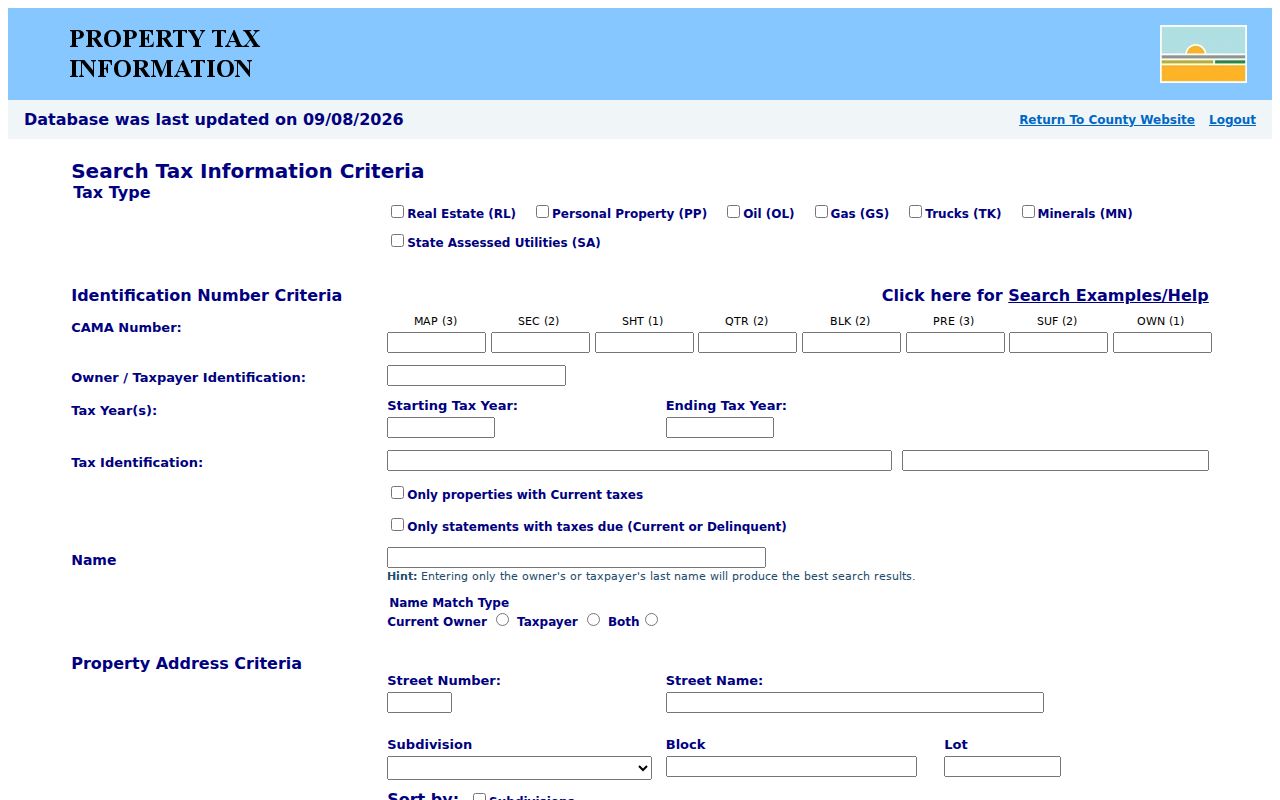
That layout shows why a Quick Ref, tax unit, or legal-description route beats a name alone. A name alone can match several taxpayers.
Find a Harper County Tax Bill
A careful lookup keeps the year and parcel together. Go broad only when no parcel ID exists. The portal prefers a plain surname, though an address search is safer when several taxpayers share one. Write down the Tax Unit, Parcel, CAMA, or Quick Ref from the matching result. Do that before changing years.
- Select Real Estate and enter the address, owner surname, or a known parcel identifier.
- Match the situs address and legal description before relying on the account.
- Choose the tax year and review whether the statement is current, paid, or delinquent.
- Save the identifiers and contact the Treasurer when payment timing or a pending collection step matters.
The portal is not the only channel. The Treasurer answers bill and payment questions at 620-842-5191 or at 201 N Jennings in Anthony. Value and record-card questions belong to the Appraiser. Some records never appear online. For those, a written KORA request can go through the County Clerk in person, by mail, or by email. State the parcel, owner, record type, and date range precisely.
- Assessed value
- The class-based share of actual value used to calculate property tax.
- Mill levy
- A tax rate expressed in mills and applied to assessed value.
- Homestead relief
- A statutory reduction that applies when the property and owner meet the stated rules.
- Tax lien
- A legal claim tied to unpaid property tax, distinct from a routine unpaid balance display.
Harper County's Annual Value Cycle
The Harper County Appraiser values real property every year. January 1 is the fair-market-value date. Residential analysis uses sales from the prior three years. Other property may involve comparable sales, cost less depreciation, or income. The work pulls from many sources. Deeds, subdivision maps, building permits, contractors, and on-site inspection all feed the record. Inspection or remeasurement comes at least every six years.
This cycle explains a common surprise. A Harper County property tax record can shift without any new deed. Market conditions play a part. So do corrected property facts, a remodel, new construction, or a sale, each in its own way. Keep the Change of Value Notice with the property card. That pairing shows the reason behind a change.
The schedule also settles who to call. Acreage, class, improvements, and the January 1 value belong with the Appraiser. Money received, amounts still due, and payment application belong with the Treasurer. Sending the parcel number, tax year, and the exact disputed field helps route the request.
Kansas Classes Shape Harper Tax
Under K.S.A. 79-1439, residential property is assessed at 11.5 percent of fair market value. Commercial and industrial property uses 25 percent. Agricultural land is taxed at 30 percent, and vacant lots sit at 12 percent. Other classes carry their own statutory rates. Classification matters as much as full value when comparing two Harper County property tax records.
Hold off comparing tax totals until the class, assessed value, tax unit, and tax year all match. Different units can carry different levies. A city parcel and a rural tract may have similar actual values. But they may not share the same tax result.
Harper County Residence Relief
Kansas exempts residential property from the statewide school levy. Under K.S.A. 79-201x, the exemption covers the first $75,000 of appraised value for taxable years 2024 and later. It applies to that levy only. Other charges on the bill stay in place.
If the relief is missing from a tax statement, start with the property class in the county record. The Appraiser can explain how the parcel is classified and what documentation the owner needs. The Treasurer can then explain how the credit or levy appears on the tax statement.
Harper's 2026 Value Notice
An April 3, 2026 county notice pointed to a typical market-condition increase. The increase was roughly three percent. It drew a line between that broad adjustment and value changes. Those changes came from remodeling, new construction, or a sale. That distinction matters when reviewing property tax records. First identify the reason category. Then test the facts behind it.
The notice was a countywide clue, nothing more. It was not a monthly price index. It did not prove every parcel rose by the same amount. A specific property's own notice and card remain the source that counts.
When the notice amount seems off for a property, compare the land and improvement facts. Do that before leaning on nearby sale prices alone. A wrong square-foot figure, class, use, or parcel match calls for a factual correction. A disagreement with the county's market conclusion calls for valuation evidence instead. The two issues are related but different. The informal conference goes more smoothly once the owner names which one is at stake.
Request Harper County Tax Detail
The portal does not always supply enough detail. For deeper records, the Appraiser lists two items. Property record cards and Change of Value Notices cost $3 each. Printed or copied documents run $1 per page. A custom query carries a $5 charge plus $25 in setup. Staff time is listed from $18.75 to $40 per hour. Electronic delivery runs $5. GIS custom work is listed at $20 per hour with added per-feature pricing.
Ask for the smallest defined record set that answers the question. Include the address, CAMA or Quick Ref, owner name, and tax year. Fees can change, so confirm the estimate before staff begins any custom work.
Contest a Harper County Assessment
K.S.A. 79-1448 gives an owner 30 days after the valuation notice to appeal. The first step is an informal meeting with the Appraiser. Bring the notice, the property card, photographs, and measurements. Also bring sale evidence and any fact showing the county record is wrong. The informal meeting cannot itself produce an increased value. From there, an appeal may proceed through the hearing route. Or it may go to the Kansas Board of Tax Appeals, as applicable.
Protect the deadline. File within 30 days of the valuation notice and keep proof that the Harper County appeal was received.
A payment-under-protest route opens once the valuation-notice period has passed. The Treasurer says to file by December 20. Payment made later has the same protection if that comes first. An escrow or mortgage-company payment has a January 31 deadline. Full payment and the form are required, followed by an appraiser meeting. These routes are time-sensitive, so verify the current form and date with the county office.